This review was published in the Winter 2025 issue of the Ver Poets members’ newsletter, Ver Poets Poetry World. To join Ver Poets and receive a free copy of the newsletter together with the other benefits of membership visit their website here.
Beware the Exploding Yogurt Pot by Heather Cook (Drawings by Heather Moulson) Crystal Clear Books (e-book £4.50, paperback £8.99)
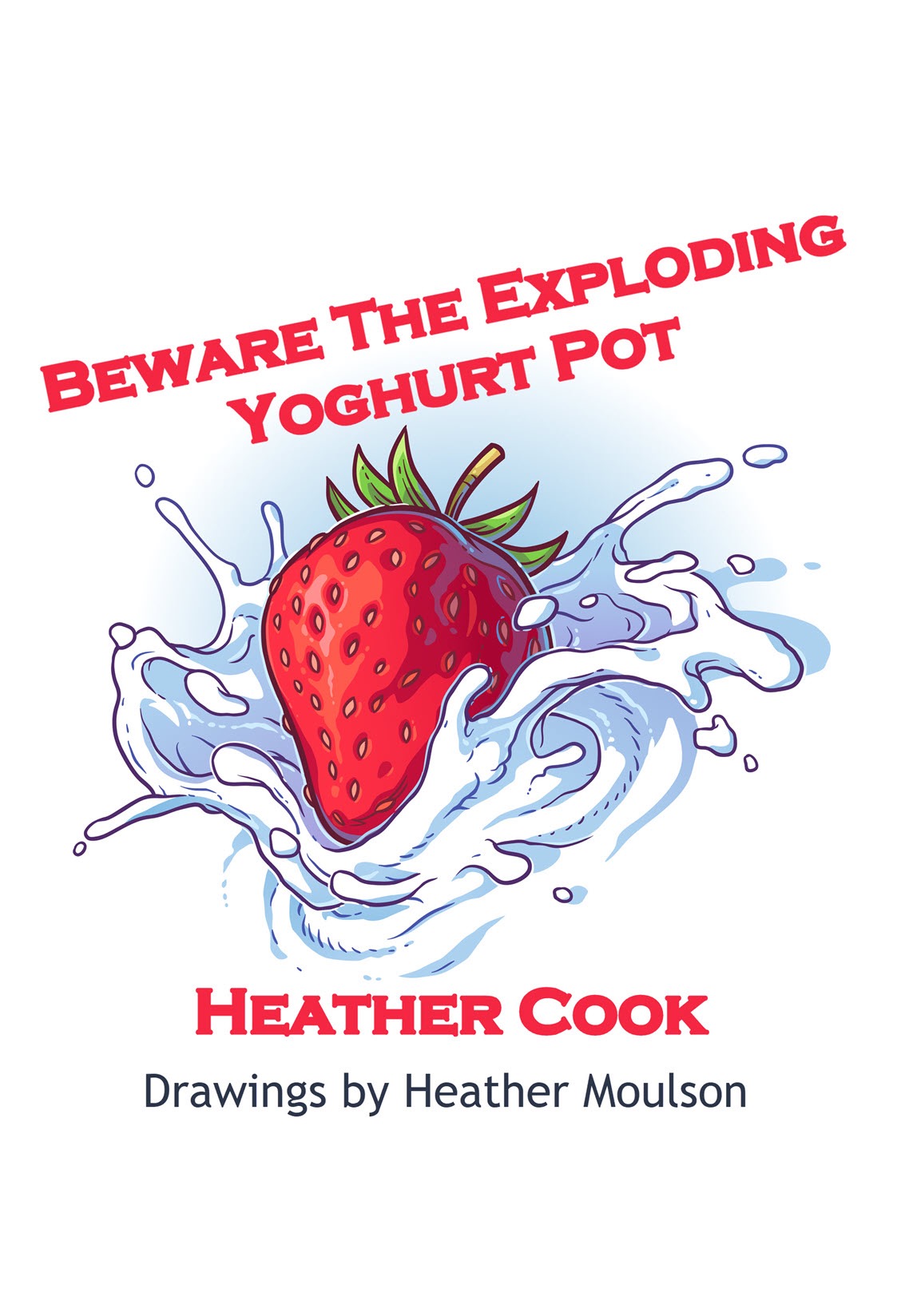
Heather’s Cook’s second pamphlet, Beware the Exploding Yogurt Pot, deals with her recent experience of being diagnosed with and treated for breast cancer. Despite claiming that the ‘bravery of fellow patients has made me conscious of my own wobbliness’, it’s a situation that she faces with remarkable courage and stoicism.
The title poem sets the tone. Yoghurt, a note explains, ‘is generally thought to be a “good thing”, until it explodes. And that unfortunate episode is exactly what I thought of when cancer suddenly threatened my very contented life in the summer of 2024.’ The book’s delightful quirkiness is perfectly matched by Heather Moulson’s drawings, as we follow Heather C’s progress from ‘lippy old bag’ to ‘lippy, bald old bag’ and beyond through sections headed ‘Shock And Rage’, ‘Preparation’, ‘Acceptance’ and ‘Trudging Down The Pathway’.
‘The content of this pamphlet,’ she says in an Author’s Note, ‘breaks every rule that I have ever tried to follow as a writer and particularly as a poet. The poems and observations are raw, rude and real.’ However, they aren’t simply outpourings, but carefully-constructed poems in a book that moves seamlessly between free verse, rhymed quatrains and prose commentary.
While she doesn’t seek to deny the rage that underlies her diagnosis—whether it’s feeling like a rebellious teenager again, or when her oncologist describes her tumour as ‘Small and aggressive’, thinking ‘For a moment … he was referring to me’—her dominant attitude is one of self-deprecation, constrained perhaps by hearing her mother’s voice saying: ‘Of course, far worse than having cancer / would be to make a silly fuss.’ When the chemotherapy leads to temporary baldness, she can’t avoid comparing herself unfavourably with Sinead O’Connor and in a poem likening the natural regreening of a beech tree to the regrowth of her hair, this symbol of hope is undercut by the observation that: ‘The ancient beech needs leaves to live, / my hair is merely vanity.’
The main strength of the book is its focus on detail, the mind clinging to small facts in the face of stress (one poem ends ‘if I wear my lucky shoes, / might it be different?’ and another with ‘A glass of water. My time is up. / Nurse tells me parking will be free.’) Misfortunes unrelated to her illness, such as having her car scraped, act as distractions, though breaking her ankle in a fall is rather more than that. The trials of diagnosis and treatment can be major (a trip to A&E when a catheter works loose from a vein) or minor, such as the awkwardness of hospital gowns (‘Why can’t I stand before you, / nurses, doctors, / nobly naked?). Her sense of taste is altered by chemotherapy (‘It’s a feature, I’ve been told, / the chemo mouth that tastes like lead’). Her perception of time changes, too: ‘The days cannot help their passing. / Sometimes they slow, or gather speed’. While the progress of the book is mostly chronological, the pacing is varied. Having several poems leading up to diagnosis heightens the anticipation. A later poem fast-forwards to day surgery and its aftermath, during a brief respite (‘But that’s to come in 4 days’ time – / Today’s a shopping spree.’) It’s the when rather than the where that briefly eludes her after a nap in “When Am I?” (‘“When” comes slowly into view, / pulling on its shoes, / wondering where it left its specs.’)
Heather Cook has said that during her worst times she was unable to concentrate on anything other than writing. In that sense, poetry has been her salvation. The poems in this book should provide helpful support for those who are undergoing or have undergone similar experiences either directly or indirectly. They are, however, well worth reading simply for themselves.
Stephen Claughton
 Stephen Claughton