Three members of Ver Poets have recently published new collections, all of which I recommend.
Can the Dandelions Be Trusted? by Katherine Gallagher (Arc Publications, £10.99)
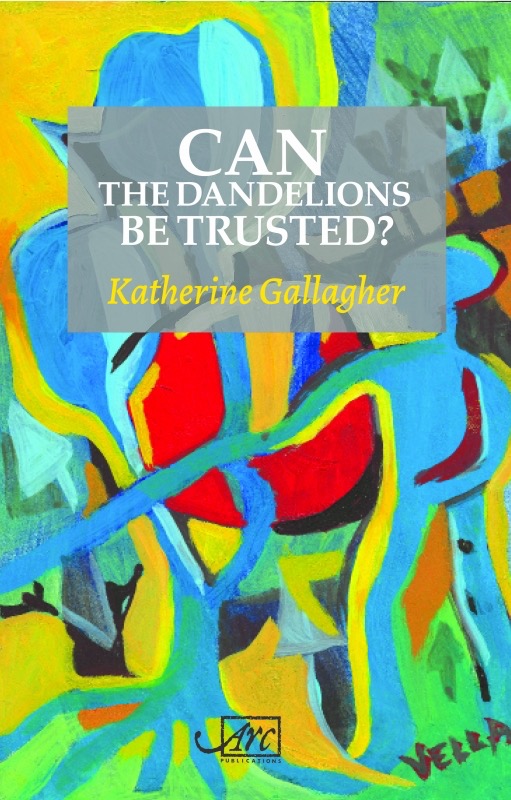
In her seventh full collection, Can Dandelions Be Trusted?, the award-winning poet, Katherine Gallagher, writes about impressions and events ranging across the whole of her long life. Originally from Australia, she first moved to London at the end of the 1960’s and has lived there since, apart from a period spent working in Paris. There are poems about Delphi, Melbourne, Venice, Paris, Sicily, India and Ireland. ‘I wish I was travelling with you – / to new places, taking our time,’ she says in her poem, “Wishes”, but although in her later years her world has necessarily shrunk to the area of North London where she lives, in terms of her poetry it makes little difference. A poem called “Early Morning, Lake Monte Generoso” sits happily cheek by jowl with one called “Broomfield Park”. She is a close observer, who delights in things being various. The title poem, with which the collection begins, contains not just dandelions, but ‘marigolds pouting as if they’ve just discovered / their proper name calendulas’, as well as seven other garden flowers. Like the dandelions, they are competing for space: ‘My garden knows me but that doesn’t stop it / being tricky’. In “Delphi Sonnet”:
Butterflies weave in and out in a chorus-line,
Clouded Yellows, Red Admirals, Meadow Browns,
kaleidoscopic among wildflowers – dandelions, daisies,
buttercups – yellows, mauves, whites.
Colours are important. “The Tides Are In Our Veins” takes us to beach scenes in Melbourne, Venice, Margate and Sicily, in which the sea is variously described as ‘cobalt’, ‘sapphire’, ‘cerulean’, ‘ultramarine’ and, more unusually, ‘mazarine rinsed to perfection’. In “Spectrum”, prose poems about three different colours, she even manages to make beige sound interesting.
Although alive to the natural world, she can also be an urban poet. Among the flora and fauna in the first section, we find “Les Lumières de Paris”:
From way off out of darkness, we saw it,
city glittering, streets garlanded,
radiating out in frosty air – Place de la Concorde,
Madeleine, Notre Dame, Tour Eiffel, Quartier Latin,
and, as if to emphasise this side of her work, each of the subsequent three sections begins with a poem about or set in a city—London in “The Uses of Snow”, then “Song for a City” and the cathedral in “Chartres”. Although there is considerable overlap among the contents of the four sections, they focus on different aspects of her life: the first is predominantly about the world around us; the second has poems about her family, including her Irish ancestors and the forbear who emigrated to Australia, as well as about her own move to London, following an unhappy love affair, and an elegy for her brother, whom she imagines ‘flying like a shadow / near my plane’; the third deals with her childhood and her regret that she didn’t move to Europe earlier to study the piano (‘To think she’d once played for Rubinstein’) and has poems about other women; the fourth deals mainly with her life in London.
As an experienced poet, she makes good use of a variety of forms, including the sonnet, villanelle, cinquain, tanka, haibun and prose poem. She also displays a particular fondness for anaphora. Though technically accomplished, she favours a plain style, which in her hands is both assured and expressive. Her poem, “A Clear Lolly Moon”, could be taken as an apt description of her poetry: ‘heavenly-waltzer, / serene / in the moment // with no pirouettes / no tango / no cake-walk / she’s an old face / at home / in her own skin’.
From There to Here by Louise Walker (Dithering Chaps, £9.95)
Louise Walker imagines her dead brother not as a shadow accompanying a plane, but as setting off on a sea journey: ‘my handsome adventurer, / always braver than me – / you must begin the voyage, / I must return to shore.’ Several of the poems in her first collection, From There to Here, deal with his sudden death, two decades before, at the age of 24. Photographs help to bring the past alive. In “Big Sister” there are two: one in which they are ‘crossing an empty beach / with buckets and spades, / you placing your feet / exactly in my footprints’; and another in which ‘we are older, / in front of your first/last car; / I can still feel your arm / around me.’ The change in the dynamic of their relationship is deftly conveyed by the details. She doesn’t gloss over the problem of sibling rivalry. In “The Swing”, a moving poem in terza rima, she wonders if she pushed the swing that hit her young brother, because ‘the swing’s unpredictable to and fro / showed love and jealousy can both be true’.
We are introduced gradually to his death. In “Cold Dead Matter”, inspired by Cornelia Parker’s installation, “Cold Dark Matter: An Exploded View”, the disassembled poem explodes across the page, describing an unspecified, cataclysmic event that begins with ‘a phone call at dawn’. The bad news delivered in “Messenger” isn’t spelt out either, although—like her mother—we can guess:
I’m buzzing her flat let me in, Mum
and I know she knows now, like on TV
when the person about to be bereaved
opens the door to two police officers
and sees that one of them is a woman.
Only in the death-as-a-voyage poem, “Hold”, does it come fully into focus. “Ars Poetica; 6pm” describes dealing with the immediate aftermath, including a lesson she gives about Tennyson’s “In Memoriam” (‘today’s task: How does the poet / explore the process of grief in this poem?’):
We squeeze the last tear from every word
and metaphor, until I come to a sudden
stop at the bleak monosyllables:
He is not here.
Other poems describe remembering him after many years. In one, she imagines him living on. In another, she lists events he has missed by dying young.
Time is a key concern not only in the poems about her brother. It may be fluid, as in “Stanley Dock”, where a young version of her father meeting her from the train turns out to be his sister’s grandson, or frozen, as in “Jug” about Vermeer’s “Milkmaid” and ‘that bright stream that will never end’. Defiantly, she celebrates coming to things late in life, whether it’s learning the flute or eating a lobster. Perhaps it’s her interest in things ever changing but never changing that prompts her fondness for poems about the seashore, two of which bookend the collection.
Her poems are marked out by their clarity and economy, but they also use imagination. “From Here to There”, a companion piece to the title poem, has her recollecting in period detail (with references to ‘the Corona lorry’ and ‘the coalman driving / his horse-drawn cart’) a day when as a toddler she went missing, walking on her own to the local park. “From There to Here” also recounts a childhood journey, but one that is purely imagined, when she visualises herself at the age of eight climbing ‘the stepped / glass roof of Lime Street Station’, before coming down to earth ‘alone in this hotel bar’.
Alive Among Dead Stars by A C Clarke (Broken Sleep Books, £12.99)
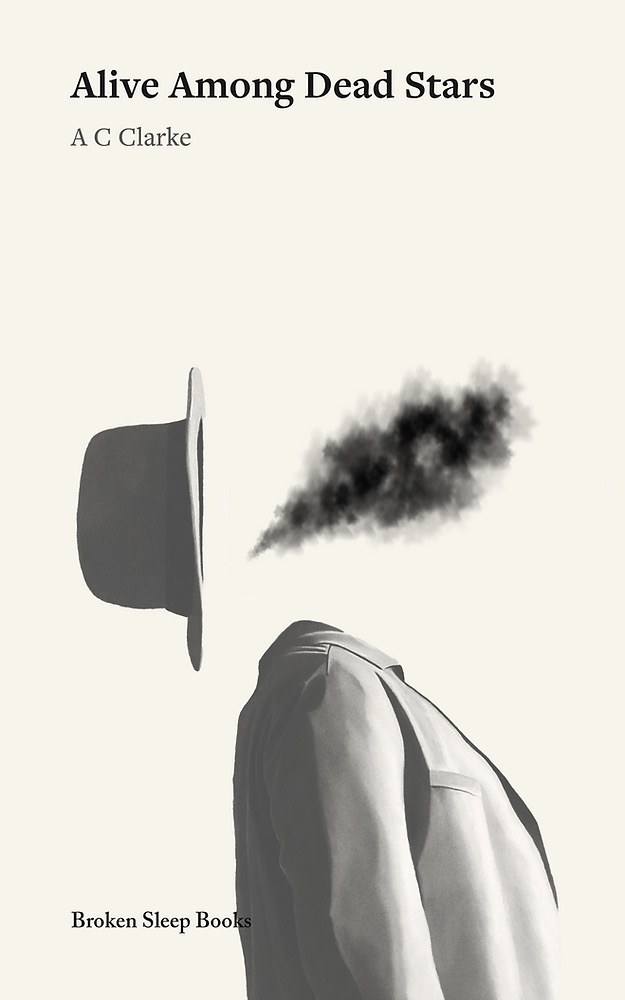
With A C Clarke’s sixth full collection, Alive Among Dead Stars, we are back in Paris with poems about the emergence of Dadaism and Surrealism in the inter-war period, focusing on the poet Paul Éluard and his wife Gala, who also had an affair with Max Ernst and later married Salvador Dalí. Paris herself speaks as a character in several of the poems (‘Dada burst onto my streets like a clown’s car’).
Described as a deliberately fragmented exploration, drawing on elements used by the Dadaists and Surrealists themselves (the titles of the book’s three sections are “Erasure”, “Collage” and “Paranoia”), the poems come with helpful notes and an afterword. Historical context is also provided by a series of “newsflashes”, parts of which are struck through in the style of erasure poetry, but which in this context suggests a sub-editor taking a blue pencil to the text. An intriguing poem, “Erasures”, plays on the way that so many of the Dadaists and Surrealists adopted names different from their birth names. The complexities of the Éluard-Gala-Ernst ménage are presented concretely in a poem suggested by Éluard’s “Berceuse”: ‘Gala and Paul and Paul and Gala and Gala and Paul and Gala and Gala and Paul and Max and Gala and Gala and Max and Paul and Paul and Gala and Gala and Gala and Max’. Other poems, the notes tell us, contain scrambled versions of the author’s own translations of poems by Éluard, who also provides the title for the collection.
If this sounds forbiddingly modernist, it isn’t. A storyline is provided by poems in the form of chatty letters from a fictional character, a young American called Ricky, to his art-dealer father, who has sent him to scout for works by up-and-coming, avant-garde artists:
Well Poppa, here I am in gay Paree
with my guidebook, my letters of introduction, my French-
English dictionary. I need to be close to the action
you said, so I got me this garno five floors up
on the Rue St Vincent in back of Sacré Coeur …
The action includes various Dadaist shenanigans, culminating in Tristan Tzara telling attendees at a Max Ernst show that he’s poisoned one of the orangeades they’ve just drunk. After this, Ricky tells Poppa that he’s ‘had it with Dada.’ He’s taken up by the poet, René Crevel, ‘who’s in with the Breton crowd’ (a close friend of Dalí and Gala, he committed suicide in 1935), but after witnessing the infighting among the Surrealists, with André Breton convening a Tribunal to expel Dalí for allegedly supporting Hitler, Ricky decides that ‘Dada was fun.’ The high-jinks don’t stop there: Ricky gives his sister an account of Dalí delivering a lecture in a diving suit and having to be rescued from suffocation.
In the first section, “Erasure”, we are under the shadow of the Great War, with poems about a visit to a war cemetery and about the coffin of the unknown soldier being brought to Paris. The second section, “Collage”, focuses on the Éluard-Gala-Ernst relationship and the third, “Paranoia”, deals with the lead-up to the Second World War. More broadly, we move from the Dadaists, who initially turned their backs on politics following the First World War—which is perhaps why the early newsflashes are pared down to the minimum (the first reports ‘The Treaty of Versailles is signed in Paris’)—to the political engagement of the Surrealists (Breton, Éluard and Louis Aragon joined the French Communist Party). The later newsflashes have interpolations rather than redactions (‘Hitler was in prison for what he considered “poli(e)tical (c)rimes” …The book will become a (best)-sell(er) in Nazi Germany’), suggesting news being spun rather suppressed. The Surrealists’ bickering becomes a microcosm of wider clashes, the sequence ending with the occupation of Paris and the dispersal of the cast (mostly to America, although Éluard and his wife Nusch joined the resistance), after which: ‘The century’s next half is loaded / into the projector ready to run.’ This is a lively and informative collection and a rare example of experimental writing that remains accessible.
(My reviews of all three collections were published in the Spring 2025 issue of the Ver Poets members’ newsletter, Ver Poets Poetry World. To join Ver Poets and receive a free copy of the newsletter together with the other benefits of membership visit their website here.)
 Stephen Claughton