Byron: A Life in Ten Letters by Andrew Stauffer (Cambridge University Press. £25.00.)
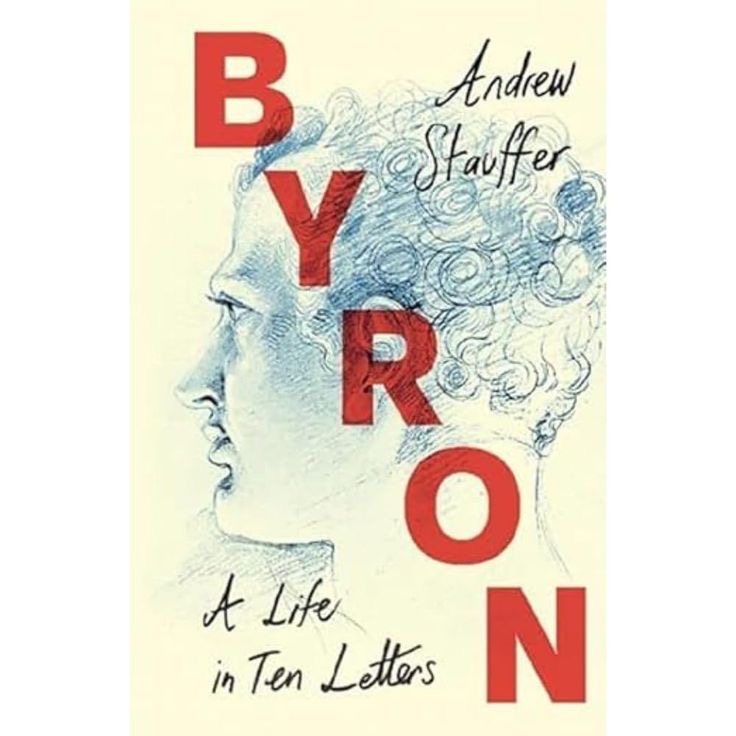
One of the books published this year to coincide with the two hundredth anniversary of Byron’s death is an excellent biography by the American academic, Andrew Stauffer, structured—as its title suggests—around ten of Byron’s letters. As Stauffer acknowledges, similar strategies have been used in, for example, Lucasta Miller’s Keats: A Brief Life in Nine Poems and One Epitaph, but basing it on the letters is a particularly good way of approaching Byron, who was a prolific correspondent—there are some 3,000 letters: ‘to family members and lovers, to his publishers and bankers, and to the same friends who would one day torch his memoir.’
Lady Caroline Lamb may have described him as ‘mad, bad and dangerous to know’, but to his friend, Lady Blessington, Byron was a more complicated figure. She saw him as ‘a chameleon-like character’: ‘if ten individuals undertook the task of describing Byron, no two, of the ten, would agree in their verdict respecting him’. When she first met him, towards the end of his life, she was expecting a Byronic hero, ‘dignified, cold, reserved, and haughty’, but instead encountered a smallish, gossipy, bantering and mercurial person, whose greatest defect ‘was flippancy, and a total want of … natural self-possession and dignity’—more Don Juan, then, than Childe Harold.
Byron shifted the style and subject of his letters to suit the occasion and his correspondent. Writing to Lady Melbourne (mother-in-law of Lady Caroline Lamb) about passing a love note to the wife of his host and friend, James Wedderburn Webster, practically under her husband’s nose, he uses the style of an epistolary novel to describe events as they happen. He sends a deeply-wounded letter to his wife, after she has left him along with their baby daughter (who, as Ada Lovelace, was to become the world’s first computer programmer). There is a racy letter to his publisher, James Murray, about his involvement with the fierce-sounding Margarita Cogni, a baker’s wife and his main, but by no means only, Venetian mistress, and a letter in Italian to the Countess Teresa Guiccioli, with whom he had a more serious, long-term relationship and whose family’s involvement in Italian nationalism rekindled his interest in the Greek cause.
Stauffer begins with a letter from Cambridge, in which Byron announces his acquisition of a bear (dogs were banned in college), and ends with one written from Missolonghi two months before his death. By then, he had only a bulldog and his Newfoundland retriever, Lyon, having divested himself of a menagerie that at one time, according to Shelley, included: ‘ten horses, eight enormous dogs, three monkeys, five cats, an eagle, a crow, and a falcon; and all these, except the horses, walk about the house, which every now and then resounds with their unarbitrated quarrels, as if they were the master of it … P.S. I find that my enumeration of the animals in this Circean Palace was defective … I have just met on the grand staircase five peacocks, two guinea hens, and an Egyptian crane. I wonder who all these animals were before they were changed into these shapes.’
In between, there are letters marking the main periods of Byron’s life, including his early travels in Albania, Greece and Turkey, during which he swam the Hellespont (his deformed foot ruled out most forms of exercise, but he was an excellent swimmer), gave free rein to his bisexuality and first became interested in the cause of Greek independence. There are the London years, when he ‘awoke one morning and found myself famous’ on the publication of Childe Harold’s Pilgrimage and when he had his notorious affair with Lady Caroline Lamb. There is his short-lived marriage to Annabella Milbanke and the incestuous relationship with his half-sister, Augusta Leigh, followed by permanent self-exile from England and years spent in Venice and elsewhere in Italy. Throughout it all, Byron found time to write poems as well as letters and the book, which is as much about the poetry as the life, plots his development from the Romanticism of Childe Harold to the astonishingly free and flexible style of Don Juan, which is his major achievement. (Shelley described its language as ‘a sort of chameleon under the changing sky of the spirit that kindles it.’)
Byron’s relationship with Shelley is a thread that runs throughout the book. He writes to his half-sister from the Villa Diodati on the shores of Lake Geneva, where he and the Shelleys were living, during the ‘year without a summer’ that gave rise to Byron’s poem, “Darkness”. It was there that Mary Shelley wrote Frankenstein in response to Byron’s suggestion of a friendly ghost-story-writing competition. Although Shelley strongly disapproved of Byron’s debauched lifestyle in Venice, he had an unconventional ménage of his own, having left his wife and two small children to travel on the Continent with the step-sisters, Mary Godwin and Claire Clairmont. Shelley married Mary, but also had an affair with Claire, as did Byron, their little daughter, Allegra, being passed around, until she died in an Italian convent at the tragically young age of five.
After first giving an account of getting sunburned while swimming, Byron describes to Thomas Moore the cremation on the beach at Viareggio of the bodies of Shelley and his friend, Edward Williams, drowned when their boat was caught in a storm: ‘All of Shelley was consumed, except the heart, which would not take the flame, and is now preserved in spirits of wine.’ Shelley died with a copy of Keats’s poems in his pocket, but his admiration of Byron’s Don Juan was so great that he had given up writing poetry in the last months of his life: ‘I do not write – I have lived too long near Lord Byron and the sun has extinguished the glow-worm,’ he wrote to a friend.
Byron’s sun was to set less than two years later at Missolonghi. Having developed a fever after being caught in a rainstorm while out riding, he was effectively bled to death by his doctors. As Stauffer notes in his Introduction, ‘To his contemporaries, the end of Byron felt something like the end of the world.’ The young Tennyson carved ‘Byron is dead’ on a rock, recalling it as ‘a day when the whole world seemed to be darkened’. But the letters as well as the poems bring Byron back to life and Stauffer uses them brilliantly to illuminate the life itself.
(This review was published in the Winter 2024 issue of the Ver Poets members’ newsletter, Ver Poets Poetry World. To join Ver Poets and receive a free copy of the newsletter together with the other benefits of membership visit their website here.)
 Stephen Claughton